

Virtual Private Network Market Size to Reach USD 156.0 Billion, Growing at 12.4% CAGR by 2035
Virtual Private Network Market
Virtual Private Network Market is growing as enterprises and users prioritize secure remote access, privacy, encryption, and web protection.
Virtual Private Network Market growth reflects rising demand for encrypted connectivity, secure remote access, privacy protection, and security needs across digital networks now.”
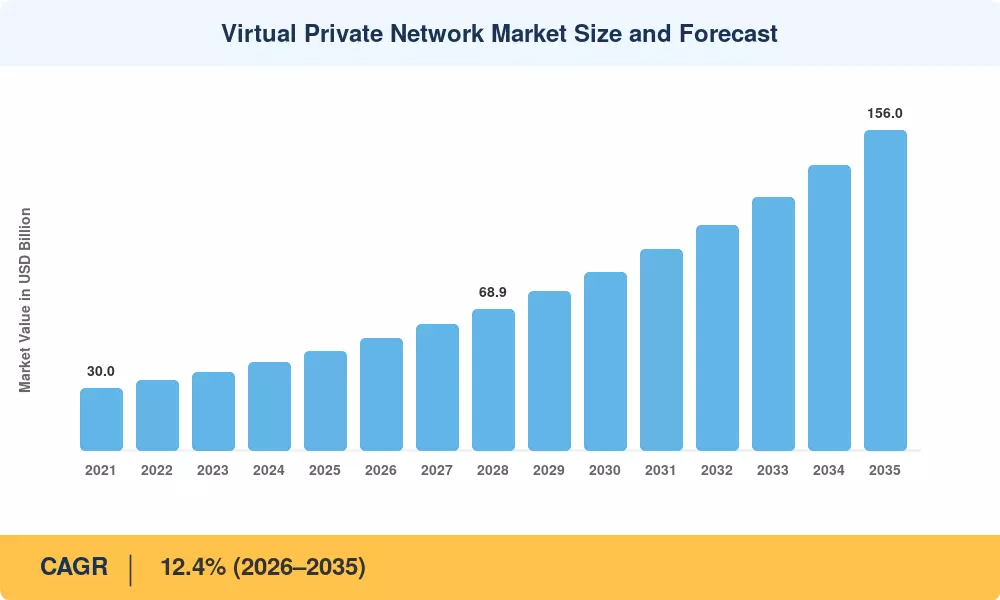
PARIS, PARIS, FRANCE, September 1, 2026 /EINPresswire.com/ -- The Virtual Private Network Market is experiencing strong expansion as businesses and consumers increasingly prioritize secure internet connectivity and privacy. The market was valued at USD 48.5 billion in 2025 and is projected to rise from USD 54.5 billion in 2026 to USD 156.0 billion by 2035, advancing at a 12.4% CAGR during the forecast period. Growing cyber threats, remote work, cloud adoption, and regulatory requirements are supporting demand for secure network access solutions.— Market Research Future
The rapid expansion of digital business operations is creating additional demand for Virtual Private Network solutions across industries. As organizations connect remote employees, cloud applications, branch offices, and distributed infrastructure, secure communication has become increasingly important. VPN platforms can help establish protected connections across diverse environments while supporting flexible access requirements. This trend is particularly relevant for businesses undergoing digital transformation and seeking scalable network security solutions.
Get a Sample PDF of the Report at -
https://www.marketresearchfuture.com/sample_request/2160
Growing Demand for VPN Security Solutions
Virtual private network solutions create encrypted connections that help protect data transmitted across potentially unsecured networks. Organizations use VPN technology to provide employees with secure access to corporate applications, systems, and resources. Consumers also increasingly use VPN services to strengthen privacy when connecting through public Wi-Fi, mobile networks, and other shared internet environments, supporting broader adoption of VPN security solutions.
Remote Work Driving VPN Adoption
The continued expansion of remote and hybrid work is increasing the importance of secure remote connectivity. Employees frequently access business applications from homes, coworking spaces, hotels, and other locations outside traditional corporate networks. VPN platforms can establish protected connections between remote users and organizational resources, helping businesses maintain secure access policies while supporting flexible working models and distributed workforces.
Cloud Computing and VPN Integration
Cloud migration is changing how enterprises design their network security architectures. Organizations increasingly operate applications across public clouds, private clouds, and hybrid environments, creating complex connectivity requirements. VPN technologies can provide encrypted connections between users, branch offices, data centers, and cloud resources. Integration with cloud infrastructure therefore remains an important factor influencing demand for modern enterprise VPN solutions.
Increasing Cybersecurity Threats
The rising frequency of ransomware, phishing, credential theft, malware, and data interception incidents is encouraging organizations to strengthen network protection. VPN technology can help encrypt communications and reduce exposure when users connect through untrusted networks. Although VPNs are not a complete cybersecurity strategy, they remain an important connectivity layer when combined with authentication, endpoint protection, firewalls, monitoring, and broader zero-trust security controls.
Enterprise VPN Software Adoption
Enterprise VPN software is increasingly being deployed by businesses seeking secure connectivity for employees, branch locations, contractors, and third-party users. Modern platforms can provide centralized policy management, authentication, access controls, traffic encryption, and monitoring. Enterprises are also looking for scalable solutions that can support thousands of users and integrate with identity management, cloud applications, endpoint security, and network infrastructure.
Buy Latest Edition of Market Study Now -
https://www.marketresearchfuture.com/checkout?currency=one_user-USD&report_id=2160
Consumer VPN Services Growth
Consumer VPN services represent another important area of market development. Internet users increasingly seek greater privacy when accessing online services, particularly when using public networks or traveling. VPN applications for smartphones, laptops, tablets, and other devices have made secure connectivity easier to deploy. Subscription-based pricing models and multi-device support are also helping VPN providers expand their consumer customer bases.
Mobile VPN Market Expansion
The increasing use of smartphones and tablets is strengthening demand for mobile VPN capabilities. Employees regularly access corporate applications through cellular networks and public Wi-Fi, creating additional security considerations for organizations. Mobile VPN solutions can help maintain encrypted connections as users move between networks. Businesses with mobile workforces therefore increasingly consider mobile security and VPN functionality as part of their broader remote-access strategies.
Cloud-Based VPN Solutions
Cloud-based VPN services are gaining attention because they can provide flexible connectivity without requiring organizations to deploy extensive hardware at every location. Businesses can scale cloud VPN capacity according to changing workforce and infrastructure requirements. Centralized administration also simplifies policy management across distributed environments. These benefits make cloud-delivered VPN services increasingly attractive to enterprises adopting software-defined and cloud-centric networking architectures.
Secure Remote Access
Secure remote access is one of the primary applications supporting the Virtual Private Network Market. VPN platforms can establish encrypted tunnels between authorized users and private organizational resources. This capability is particularly valuable for employees who need to access internal applications while working outside corporate facilities. Combining VPN connectivity with multifactor authentication and role-based access can further strengthen remote-access security.
Zero Trust and VPN Evolution
The emergence of zero trust security is influencing the role of traditional VPN technology. Zero trust emphasizes continuous verification and least-privilege access rather than automatically trusting users after they connect to a corporate network. Some organizations are therefore combining VPN capabilities with zero-trust network access solutions. This evolution is encouraging vendors to develop more granular, identity-aware, application-level connectivity and access controls.
Network Security and Encryption
Encryption remains a fundamental feature of VPN technology because it helps protect information transmitted between connected endpoints. VPN protocols establish secure communication channels designed to prevent unauthorized parties from easily viewing network traffic. Businesses increasingly evaluate solutions based on encryption strength, protocol performance, authentication capabilities, and compatibility with modern infrastructure when selecting VPN technologies.
VPN for Small and Medium Enterprises
Small and medium-sized businesses are increasingly adopting VPN services because affordable cloud and subscription-based solutions have reduced deployment barriers. SMEs can use VPN platforms to connect remote employees, secure branch offices, and protect communications without investing heavily in dedicated networking infrastructure. Managed VPN services can also provide smaller organizations with access to technical expertise and centralized administration.
North America Virtual Private Network Market
North America holds the dominant position in the Virtual Private Network Market, representing approximately 36% of 2025 revenue. A mature enterprise IT ecosystem, widespread cloud adoption, remote work, and stringent compliance requirements across industries such as healthcare and finance are supporting regional demand. Organizations continue investing in secure connectivity as they expand distributed infrastructure and strengthen protection for sensitive information.
Asia-Pacific Virtual Private Network Market
Asia-Pacific is expected to be the fastest-growing regional market, with a projected 14.8% CAGR during the forecast period. Rapid digitalization programs across India, China, Southeast Asia, and other economies are increasing demand for secure internet and enterprise connectivity. Expanding cloud adoption, smartphone usage, remote work, and cybersecurity awareness are creating additional opportunities for VPN service and software providers.
Europe Virtual Private Network Market
Europe is witnessing continued interest in VPN technology as organizations strengthen cybersecurity, data protection, and secure remote-access capabilities. Businesses across financial services, healthcare, manufacturing, government, and technology increasingly require controlled connectivity across distributed environments. Privacy awareness and evolving cybersecurity requirements are also encouraging organizations and individual users to evaluate technologies that can improve protection when accessing online resources.
VPN and IoT Connectivity
The expansion of Internet of Things deployments is creating additional connectivity challenges for enterprises. Connected devices often communicate across distributed networks and may require secure channels to reach centralized applications or management platforms. VPN technology can provide encrypted communication for selected IoT environments, while additional identity, segmentation, device-management, and monitoring controls can help reduce risks associated with connected infrastructure.
VPN and Data Privacy
Data privacy remains a major consideration in the VPN industry because users expect their online communications and connection information to be handled securely. Enterprise customers must also consider data governance, access logging, storage practices, and regulatory obligations. VPN providers are therefore emphasizing transparent privacy policies, secure infrastructure, strong authentication, and appropriate data-management practices to build trust among customers.
Challenges in VPN Adoption
Despite strong growth opportunities, VPN deployments can encounter performance, scalability, configuration, and management challenges. Encryption and traffic routing may introduce latency in certain environments, while poorly configured VPNs can create security weaknesses. Enterprises with complex networks may also need extensive integration with identity systems, firewalls, cloud services, and endpoint platforms. Vendors are responding with automated management and more scalable architectures.
VPN Performance and Scalability
Performance is becoming increasingly important as businesses connect larger numbers of remote users and geographically distributed resources. VPN platforms must maintain reliable connections while processing encrypted traffic across different networks. Cloud-based architectures, optimized protocols, distributed infrastructure, and automated capacity management can help providers improve scalability. Enterprises increasingly evaluate VPN solutions according to reliability, throughput, latency, and user experience.
Browse In-depth Market Research Report -
https://www.marketresearchfuture.com/reports/virtual-private-network-market-2160
Artificial Intelligence in VPN Security
Artificial intelligence and machine learning can strengthen VPN management by identifying unusual connection behavior and potential security anomalies. Analytics capabilities can examine login patterns, device information, connection locations, and traffic characteristics to highlight suspicious activity. AI can also support automated threat detection and policy recommendations, allowing security teams to investigate potentially compromised accounts or devices more efficiently.
Competitive Landscape
The Virtual Private Network Market includes cybersecurity companies, networking providers, cloud technology firms, enterprise security vendors, and consumer VPN specialists. Competition increasingly focuses on security, performance, ease of deployment, privacy, cloud integration, device compatibility, and centralized management. Providers are also expanding into broader secure-access portfolios that combine VPN capabilities with zero trust, secure web access, endpoint protection, and network security services.
Emerging VPN Market Trends
Several developments are expected to shape the future of VPN technology, including cloud-native VPNs, zero-trust network access, AI-assisted threat detection, mobile security, passwordless authentication, software-defined networking, and integrated security platforms. Businesses are increasingly seeking solutions that provide secure access without creating unnecessary complexity. This trend is encouraging VPN vendors to evolve from basic encrypted tunnels toward intelligent and policy-driven secure connectivity.
Future Outlook for Virtual Private Network Market
The future of the Virtual Private Network Market remains positive as organizations and consumers continue prioritizing secure connectivity and digital privacy. The market is expected to expand from USD 54.5 billion in 2026 to USD 156.0 billion by 2035, reflecting a 12.4% CAGR. Remote work, cloud transformation, cybersecurity investments, mobile connectivity, and digitalization across emerging economies are expected to remain important growth factors.
Frequently Asked Questions:
What is driving the Virtual Private Network Market?
Remote work, cybersecurity threats, cloud adoption, privacy concerns, digitalization, and demand for secure remote access are major market drivers.
What will the VPN market be worth by 2035?
The market is projected to reach approximately USD 156.0 billion by 2035, growing at a 12.4% CAGR.
Which region is growing fastest?
Asia-Pacific is expected to be the fastest-growing region, with a projected 14.8% CAGR.
Why are businesses using VPNs?
Businesses use VPNs to establish encrypted connections and provide secure remote access to organizational resources.
What is a cloud VPN?
A cloud VPN provides secure, encrypted connectivity through cloud-based infrastructure, reducing dependence on dedicated on-premise networking equipment.
How does VPN technology support remote work?
VPNs can encrypt connections between remote employees and organizational resources, helping protect access over external networks.
Are VPNs part of zero trust security?
VPNs can support secure connectivity, but modern zero trust architectures typically apply additional identity, device, application, and risk-based controls.
What are the key VPN market challenges?
Performance, scalability, configuration complexity, integration requirements, privacy concerns, and evolving cybersecurity threats are major challenges.
➤➤ Regional & Country-Level Reports by Market Research Future:
China Virtual Private Network Market -
https://www.marketresearchfuture.com/reports/china-virtual-private-network-market-62167
France Virtual Private Network Market -
https://www.marketresearchfuture.com/reports/france-virtual-private-network-market-62163
Germany Virtual Private Network Market -
https://www.marketresearchfuture.com/reports/germany-virtual-private-network-market-62161
India Virtual Private Network Market -
https://www.marketresearchfuture.com/reports/india-virtual-private-network-market-62164
Indonesia Virtual Private Network Market -
https://www.marketresearchfuture.com/reports/indonesia-virtual-private-network-market-62165
Japan Virtual Private Network Market -
https://www.marketresearchfuture.com/reports/japan-virtual-private-network-market-62162
Mexico Virtual Private Network Market -
https://www.marketresearchfuture.com/reports/mexico-virtual-private-network-market-62166
South Korea Virtual Private Network Market -
https://www.marketresearchfuture.com/reports/south-korea-virtual-private-network-market-62160
UK Virtual Private Network Market -
https://www.marketresearchfuture.com/reports/uk-virtual-private-network-market-62159
US Virtual Private Network Market -
https://www.marketresearchfuture.com/reports/us-virtual-private-network-market-13628
Market Research Future
Market Research Future
+ +1 855-661-4441
email us here
Legal Disclaimer:
EIN Presswire provides this news content "as is" without warranty of any kind. We do not accept any responsibility or liability for the accuracy, content, images, videos, licenses, completeness, legality, or reliability of the information contained in this article. If you have any complaints or copyright issues related to this article, kindly contact the author above.
