

Function as a Service Market Expected to Achieve a Strong 18.92% CAGR, to Reach USD 131.78 Billion by 2035
Function As A Service Market
Function As A Service Market enables event-driven, serverless application development with scalable, flexible, and cost-efficient cloud execution.
Function As A Service Market growth is accelerating as businesses adopt serverless computing to simplify development, improve scalability, and reduce infrastructure costs.”
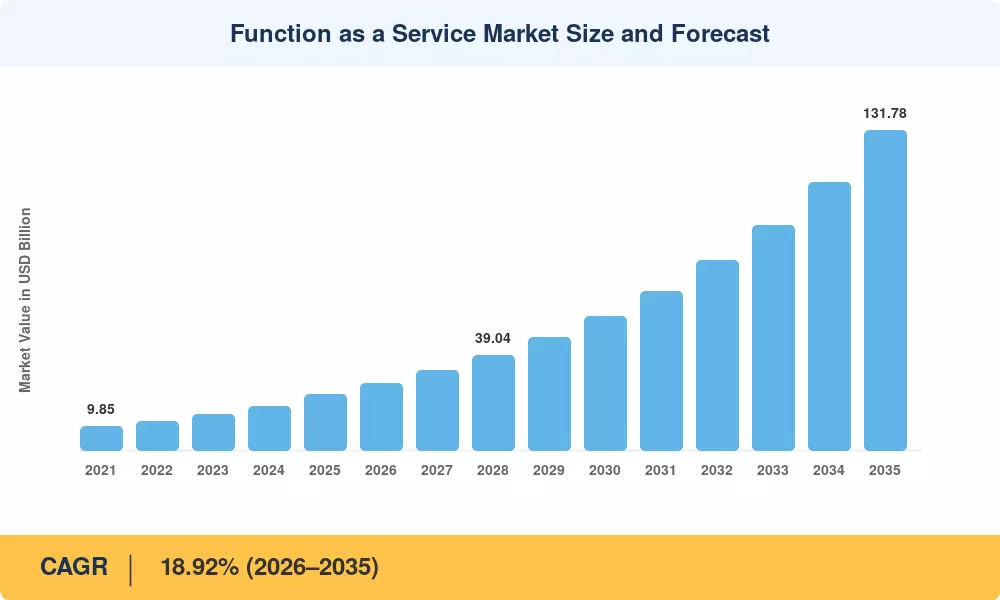
BERLIN, BERLIN, GERMANY, September 1, 2026 /EINPresswire.com/ -- The Function as a Service Market is expanding rapidly as organizations adopt serverless computing to simplify application development and reduce infrastructure management. The market was valued at approximately USD 23.22 billion in 2025 and is projected to rise from USD 27.61 billion in 2026 to USD 131.78 billion by 2035, representing a CAGR of 18.92%. Growing cloud adoption, application modernization, microservices, and demand for scalable computing are supporting market expansion.— Market Research Future
The Function as a Service Market is growing as organizations increasingly adopt serverless computing to develop and deploy applications without directly managing underlying infrastructure. FaaS enables developers to execute individual functions in response to events while cloud platforms automatically manage computing resources and scalability. The technology supports microservices, APIs, IoT applications, real-time processing, AI workloads, and event-driven architectures while potentially reducing infrastructure management requirements.
Growing cloud adoption, application modernization, DevOps practices, and demand for flexible computing are key market drivers. North America remains a dominant region due to established cloud ecosystems, while Asia-Pacific is projected to grow rapidly as businesses across India, China, and Southeast Asia accelerate cloud-based digital transformation.
Get a Sample PDF of the Report at -
https://www.marketresearchfuture.com/sample_request/3324
Growing Adoption of Serverless Computing
Serverless computing is becoming an important cloud development model because it allows developers to execute application functions without directly managing servers. Function as a Service platforms automatically provision computing resources according to workload requirements. This approach enables businesses to concentrate on application development rather than infrastructure maintenance, making serverless architectures attractive for organizations seeking faster development cycles and operational flexibility.
Rising Demand for Cloud-Native Applications
The increasing development of cloud-native applications is creating strong demand for FaaS solutions. Modern enterprises are adopting microservices, containers, APIs, and event-driven architectures to build flexible applications. FaaS allows individual application functions to operate independently and scale according to demand. This capability supports modular application development and helps organizations respond more quickly to changing business and customer requirements.
Event-Driven Architecture Growth
Event-driven architecture is a major application area for Function as a Service because functions can automatically execute when specific events occur. Events may include database updates, file uploads, API requests, application activities, or customer transactions. FaaS platforms can trigger functions in response to these events, allowing businesses to automate workflows and build responsive applications without maintaining continuously running infrastructure.
Cost Efficiency of FaaS Platforms
Cost optimization is an important factor supporting FaaS adoption. Traditional infrastructure may require organizations to maintain computing resources even during periods of low utilization. Function as a Service platforms generally operate according to resource consumption and execution requirements. This model can help businesses align computing expenditure with actual workloads, particularly for applications characterized by variable traffic, intermittent processing, or unpredictable demand.
Buy this Premium Research Report at:
https://www.marketresearchfuture.com/checkout?currency=one_user-USD&report_id=3324
Scalability and Flexible Computing
FaaS platforms provide automatic scalability that allows applications to handle changing workloads without extensive manual infrastructure planning. When application activity increases, cloud platforms can execute additional function instances to meet demand. When activity declines, resource consumption can decrease accordingly. This elasticity is particularly valuable for businesses operating applications with seasonal demand, sudden traffic spikes, or rapidly changing usage patterns.
Microservices and FaaS Integration
The adoption of microservices architecture is strengthening the relationship between FaaS and cloud-native development. Developers can divide applications into smaller functions that perform specific tasks independently. These functions can be developed, tested, deployed, and scaled separately. By supporting modular architectures, FaaS can help development teams improve application flexibility and accelerate updates without requiring changes to an entire monolithic application.
Artificial Intelligence and Machine Learning Applications
Function as a Service is increasingly being used to support AI and machine learning workflows. Developers can use serverless functions for data preprocessing, model inference, event processing, and automated workflows. FaaS can provide flexible computing resources for applications where workloads vary over time. As organizations deploy more AI-powered applications, serverless computing can help developers build supporting services without maintaining dedicated infrastructure for every processing task.
IoT and Edge Computing Applications
The growth of Internet of Things deployments is creating additional opportunities for FaaS platforms. IoT environments generate large quantities of events from connected sensors, devices, and machines. Serverless functions can process these events, trigger workflows, transform data, and communicate with cloud services. FaaS can also support edge-oriented applications where lightweight event processing is required closer to connected devices and users.
API-Driven Application Development
API-driven development is another important growth area for Function as a Service. Developers can deploy individual functions behind APIs to provide specific application capabilities. This approach enables organizations to create lightweight backend services without managing conventional server infrastructure. FaaS-based APIs can support mobile applications, web platforms, enterprise integrations, payment services, and other digital products requiring scalable backend processing.
DevOps and Continuous Delivery
FaaS aligns closely with DevOps and continuous delivery practices because individual functions can be deployed independently. Development teams can automate testing, deployment, monitoring, and version management through cloud-based development pipelines. This can reduce the time required to introduce new features and simplify application updates. The combination of FaaS, DevOps, and automation is helping organizations establish faster and more flexible software delivery processes.
Security in Function as a Service
Security remains an important consideration as organizations move application workloads to serverless environments. FaaS platforms require appropriate identity management, access controls, encryption, dependency monitoring, and secure coding practices. Developers must also consider vulnerabilities within individual functions and third-party libraries. Cloud providers continue to strengthen security capabilities, while organizations increasingly adopt automated security testing and monitoring throughout the serverless application lifecycle.
Challenges in Serverless Computing
Despite its benefits, FaaS adoption can involve challenges related to vendor dependence, application monitoring, cold starts, execution limits, debugging complexity, and architectural changes. Organizations transitioning from traditional infrastructure may need to redesign applications to take full advantage of serverless capabilities. Development teams also require specialized knowledge of event-driven architectures, distributed systems, cloud security, and serverless observability.
North America Function as a Service Market
North America holds the leading position in the Function as a Service Market, accounting for approximately 38% of revenue. Strong cloud infrastructure, extensive enterprise adoption, and established serverless ecosystems are supporting regional growth. The installed base of AWS Lambda and broad enterprise adoption of Azure Functions are contributing to the region's leadership as businesses increasingly modernize applications through cloud-native development models.
Asia-Pacific Function as a Service Market
Asia-Pacific is projected to be the fastest-growing regional market, with an estimated 22.4% CAGR through the forecast period. Digital transformation programs across India, China, Southeast Asia, Japan, and other economies are increasing demand for cloud-based application development. Expanding digital services, mobile applications, e-commerce platforms, and technology modernization initiatives are creating substantial opportunities for serverless computing and FaaS providers.
Europe Function as a Service Market
Europe is experiencing increasing demand for serverless technologies as enterprises modernize legacy applications and adopt cloud-native development. Organizations across financial services, manufacturing, healthcare, retail, and public-sector industries are investing in scalable application architectures. Data governance, cybersecurity, and regulatory considerations remain important factors influencing deployment decisions as European businesses evaluate cloud-based computing models.
Browse In-depth Market Research Report:
https://www.marketresearchfuture.com/reports/function-as-a-service-market-3324
FaaS for Small and Medium Enterprises
Small and medium-sized businesses can benefit from FaaS because serverless platforms reduce the need for extensive infrastructure management. Developers can build and deploy applications using cloud services while avoiding significant investments in physical servers. Usage-based pricing can also make serverless computing attractive for businesses with variable workloads. As cloud platforms become easier to use, FaaS adoption is expected to expand among smaller technology teams.
Multi-Cloud and Hybrid Serverless Adoption
Organizations are increasingly evaluating multi-cloud and hybrid strategies to improve flexibility and reduce dependence on a single cloud provider. FaaS environments can operate across different cloud platforms, although portability may be affected by provider-specific services and APIs. Technologies that support standardized deployment, infrastructure automation, and containerized workloads can help businesses manage serverless applications across multiple environments.
FaaS Observability and Monitoring
Observability is becoming increasingly important as serverless applications contain numerous distributed functions that can be difficult to monitor individually. Organizations require tools capable of tracking execution times, failures, dependencies, performance, and application behavior. Advanced monitoring platforms can provide centralized visibility across functions and related cloud services, helping development teams identify performance bottlenecks and resolve application problems more efficiently.
Competitive Landscape
The Function as a Service Market includes major cloud providers and specialized technology companies offering serverless computing platforms. Leading providers compete through execution performance, developer tools, integrations, security, pricing, scalability, and ecosystem capabilities. AWS Lambda and Azure Functions remain important offerings, while other major cloud platforms continue expanding their serverless portfolios. Competition is increasingly focused on simplifying development and improving enterprise-grade serverless capabilities.
Emerging FaaS Market Trends
Several trends are expected to influence the future of the Function as a Service industry, including AI integration, serverless databases, edge computing, event-driven applications, automated DevOps, multi-cloud deployment, and improved observability. Developers are also exploring serverless architectures for real-time analytics, digital commerce, automation, and connected-device applications. These developments are expanding the role of FaaS beyond simple backend functions.
Serverless Databases and FaaS
The convergence of serverless databases and FaaS is creating more complete cloud-native development environments. Developers can combine automatically scaling functions with databases that dynamically adjust capacity according to application requirements. This combination reduces infrastructure management responsibilities and enables applications to scale more efficiently. Serverless database integration is particularly valuable for modern applications with fluctuating workloads and rapidly changing data requirements.
FaaS and Edge Computing
Edge computing is creating new opportunities for serverless execution closer to users and connected devices. Deploying functions closer to data sources can reduce latency for applications requiring rapid processing. This capability is relevant to IoT, gaming, content delivery, industrial automation, and real-time analytics. As edge infrastructure expands, lightweight serverless execution models may become increasingly important for distributed computing environments.
Future Outlook for Function as a Service Market
The Function as a Service Market is positioned for substantial long-term growth as organizations increasingly adopt cloud-native and serverless application architectures. Expansion from USD 27.61 billion in 2026 to USD 131.78 billion by 2035 demonstrates significant market potential. Demand for scalable computing, application modernization, event-driven architectures, AI workloads, and cost-efficient infrastructure is expected to continue supporting FaaS adoption worldwide.
Frequently Asked Questions:
What is driving the Function as a Service Market?
Cloud adoption, serverless computing, application modernization, microservices, event-driven architectures, and demand for scalable infrastructure are major growth drivers.
What will the Function as a Service Market be worth by 2035?
The market is projected to reach approximately USD 131.78 billion by 2035, growing at a CAGR of 18.92%.
Which region is growing fastest?
Asia-Pacific is expected to be the fastest-growing region, with a projected CAGR of approximately 22.4%.
What is Function as a Service?
FaaS is a cloud computing model that allows developers to execute individual application functions without directly managing underlying servers.
What are the benefits of FaaS?
Key benefits include automatic scalability, reduced infrastructure management, flexible deployment, event-driven execution, and potentially lower costs for variable workloads.
How does FaaS support microservices?
FaaS allows developers to deploy individual application functions independently, supporting modular and scalable microservices-oriented architectures.
What industries use FaaS?
Financial services, healthcare, retail, telecommunications, manufacturing, technology, e-commerce, and media companies increasingly use serverless technologies.
What are major FaaS challenges?
Vendor lock-in, cold starts, monitoring complexity, execution limitations, security requirements, debugging challenges, and architectural changes can affect adoption.
➤➤ In-Depth Market Studies by Market Research Future:
Returns Management Software Market -
https://www.marketresearchfuture.com/reports/returns-management-software-market-31841
Landing Page Software Market -
https://www.marketresearchfuture.com/reports/landing-page-software-market-31846
Intellectual Property Management Software Market -
https://www.marketresearchfuture.com/reports/intellectual-property-management-software-market-31858
Log Management Market -
https://www.marketresearchfuture.com/reports/log-management-market-31870
5G Optical Transceiver Market -
https://www.marketresearchfuture.com/reports/5g-optical-transceiver-market-31871
Interior Design Software Market -
https://www.marketresearchfuture.com/reports/interior-design-software-market-31873
Iot In Connectivity Market -
https://www.marketresearchfuture.com/reports/iot-in-connectivity-market-31878
Cloud Finops Market -
https://www.marketresearchfuture.com/reports/cloud-finops-market-31971
Data Enrichment Solution Market -
https://www.marketresearchfuture.com/reports/data-enrichment-solution-market-31973
Hospitality Point Of Sale Software Market -
https://www.marketresearchfuture.com/reports/hospitality-point-of-sale-software-market-31977
Market Research Future
Market Research Future
+1 855-661-4441
email us here
Legal Disclaimer:
EIN Presswire provides this news content "as is" without warranty of any kind. We do not accept any responsibility or liability for the accuracy, content, images, videos, licenses, completeness, legality, or reliability of the information contained in this article. If you have any complaints or copyright issues related to this article, kindly contact the author above.
